Welcome to the third article of our feature series, Career Spotlight, where we talk to people from all over the world of esports and gaming whatever their job may be. You can become part of the interview too, let us know who you’d like to talk to and what questions you’d like to ask them!
This time we are talking to Jacob Holden, occupational therapist for SpecialEffect, about his role with the charity and how he got involved with gaming and helping people with disabilities. Enjoy!
Hi Jacob, thanks for sitting down with us, could you give our student readers an overview of what you do at SpecialEffect?
Sure, I’m an occupational therapist and part of the service delivery team at SpecialEffect. We help people with disabilities to play video games. They have the choice to either come down to our assessment games room in Oxfordshire or we can go and see them in their homes. We travel all over the UK from Cornwall to Aberdeen and see a wide range of physical conditions like cerebral palsy and spinal cord injuries. So, we create unique equipment set-ups that are completely tailored to the individual’s movements and what games they would like to play. We ask them what games and consoles they enjoy and see what movements they have. Any kind of movement can be crucial whether it’s in their hands, feet, or even chin! After we take a look at their movements, we trial some equipment that could work for them such as external switches, mounting arms, or specialised controllers. We would then loan them the equipment they need to play and see how they’re getting on a couple of months down the line, and we can see people as many times as required. This is because conditions can progress, new technology comes out and new games become available, so we do our best to keep up to date with all of these. It’s utterly incredible seeing the impact on the quality of life gaming can have for people who have never played games before or have played games in the past but haven’t been able to because an injury has prevented them from doing so.
Could you give a bit more detail on what an occupational therapist helps with?
That’s a great question, and one not so easily answered because of the many pathways occupational therapy holds. I would describe an occupational therapist as someone who promotes independence through the use of occupation. They can be found in a wide range of settings such as hospitals, schools, and charities. As humans, we all encounter occupations as part of our everyday activities such as getting dressed and going to work or school. Occupation tends to fall into 3 categories: self-care, productivity and leisure. At SpecialEffect, we’re focused on the leisure aspect of gaming and trying to bring fun and inclusion into people’s lives, which is personally my favourite aspect because who doesn’t like having fun?
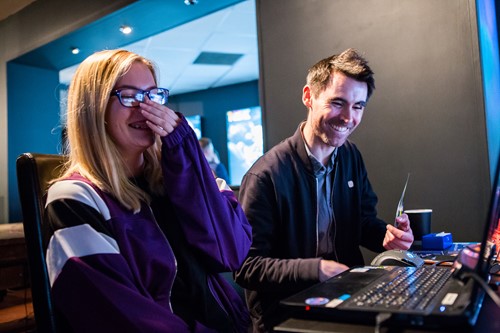
A Student tries out SpecialEffect's eyetracker for racing games.
And what was it that made you choose to get involved with SpecialEffect?
I hadn’t heard of SpecialEffect until I began job hunting. I had just qualified as an occupational therapist in May 2018 and was looking for more traditional occupational jobs such as working in hospitals because they tend to be more popular. It was only by luck that I came across SpecialEffect via a job website. I saw the words “video games” and “occupational therapy” and thought that’s the job for me, so I did all I could to get that job. I went to visit them and get a better idea of what they do and read up on their website. The more I thought about working there, the more excited I got. Researching the job position didn’t feel like a chore, I actually enjoyed it because gaming is one of my greatest passions and the idea of bringing that passion to other people was such an exciting prospect. Now that I’m working at SpecialEffect, I’m exactly where I want to be in life, it’s like work has become play.
Do you see gaming as a useful way helping people approach occupational therapy?
I never considered gaming to be so central in people’s lives that it falls into occupational therapy. Since working here, I’ve realised how incredibly complicated gaming can be for someone with a disability. Having to press multiple buttons simultaneously, using small joysticks together, and the small and precise movements required can be such a challenge. Occupational therapy promotes leisure and gaming does just that. Despite our focus at SpecialEffect being leisure, gaming also has other positive benefits such as improving coordination and bringing a social aspect into people’s lives because they can play with their friends and family. The quality of life can improve substantially through gaming which is what occupational therapy is all about.
Was there much of a gaming society at Coventry while you studied there?
I never thought about gaming societies when I attended, I was too focused on my trampolining society! Thinking back, I wish I did take a look more into gaming societies because since working at SpecialEffect, I read about a lot of them across various universities and it looks like so much fun. In my head, because I played games in between studying (or sometimes instead of), I felt I could do without extra gaming in my life, but if I went back to university now, I’d definitely join one without question.
How can people get involved with SpecialEffect?
As there’s quite a number of ways, it best to take a look at our website https://www.specialeffect.org.uk/get-involved and see what takes your fancy! We’re also really excited you’re running the National Student Fundraising Campaign with us, so people can donate via https://www.justgiving.com/campaign/NSE2019.
Why not check out the great work SpecialEffect are up to over on their Twitter.
FOLLOW NSE
Twitter - Instagram - Facebook